
Point of Sale, also known as the Point of Purchase, is the place at which a retail transaction is carried out. Before computerized POS systems were developed merchants would have to rely on their own organizational and math skills to run their business. As you can imagine this wasn’t the most efficient way of doing things, especially for small businesses low in staff members who would rely on only a handful of people to keep track of stock, pricing, orders, etc… Luckily for us, we live in the 21st century where Point of Sale software has now been around for decades.
The Very First
One of the very first POS systems was developed by IBM in the summer of 1973. This new, innovative system was the first commercial use of client-server technology, peer-to-peer communications and remote initialization. The programmability, something retailers never had before, allowed them to be more creative, even though the customization was fairly basic. Restaurants that implemented this software could now take customer orders at the till and print preparation details straight to the kitchen. After a short wait, customers would continue to their tables with their food already waiting for them! Slightly later software would also include labor and food expenditure reports. These innovations fundamentally changed what the Point of Sale was, paving the way for newer, smarter systems.
Pre 1990
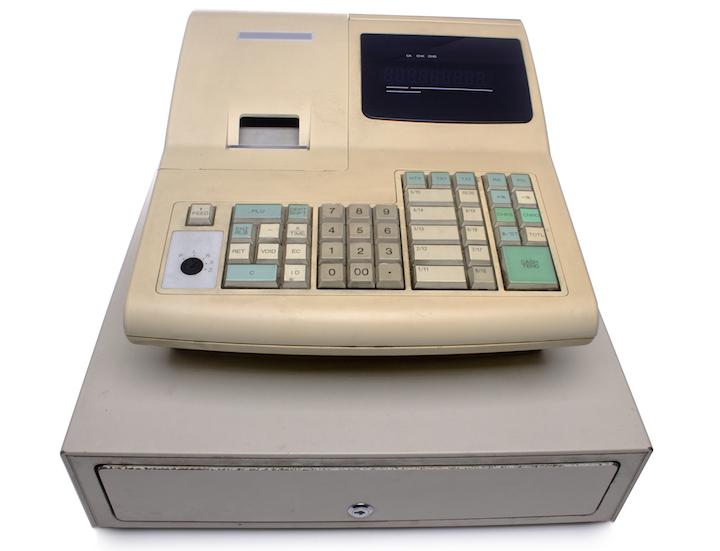 Fast forward a few years and POS systems were widespread across all sectors, particularly in hospitality and retail. These antecedent electronic cash registers had limited function and communication capabilities and were controlled mostly with proprietary software. However, in 1986 the first-ever graphical touchscreen POS device was created, the ViewTouch. It was the first of its kind, featuring a color touchscreen and a configurable interface to alter menu items without the need for programming. If the success of a product can be measured by shelf life, the ViewTouch is a remarkable accomplishment, it’s still being used today! Both hardware and software was in constant development, showing no signs of slowing down. Business owners were eager to implement a POS system that could increase efficiency, help them organize and ultimately boost profits. Because of this, retailers and POS vendors worked to standardize the development of computerized Point of Sale systems and to simplify the interconnectivity of Point of Sale devices. The UnifiesPOS standard, to which all POS systems had to conform, was led by The National Retail Foundation. The initiative’s goal was to set base requirements and to allow for freedom of choice among retailers regarding the selection of POS.
Post 1990
 At a time when computers were becoming commonplace, POS vendors had to adapt their software to maximize its potential. IT Retail was created in 1992 and this system was the first that could run on the Microsoft Windows platform. Its makers, Martin Goodwin and Bob Henry, are essentially the godfathers of modern POS, this being the critical moment that preceded a slew of Point of Sale applications being developed specifically for Microsoft and Unix operating systems. Components to build these systems became substantially cheaper due to their prevalence, leading to another huge explosion in POS systems in the mid-to-late 1990s. Highly powerful and flexible systems were developed to suit a multitude of retailers.
Post 2000 and The Future of POS
